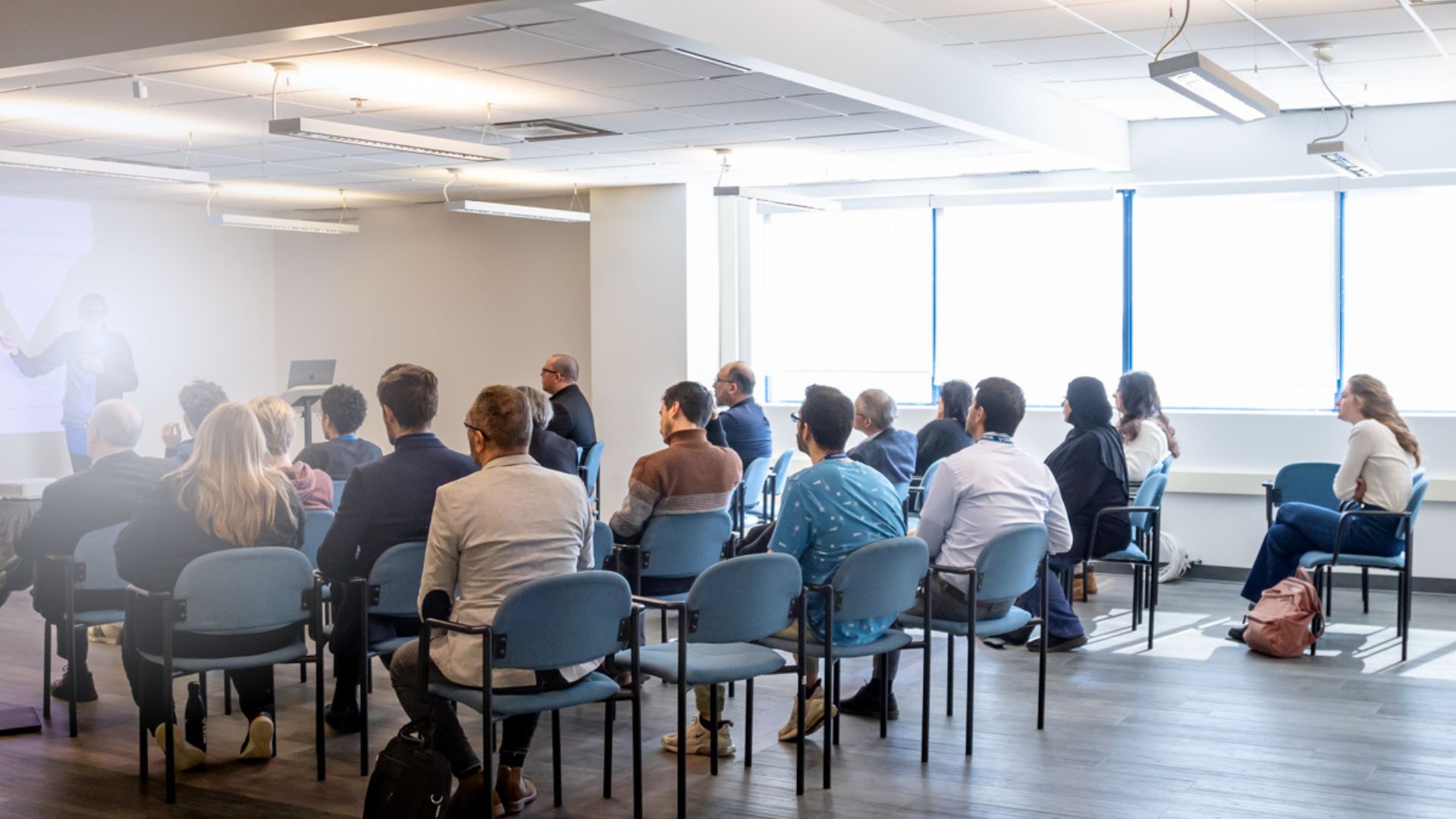
At CRIM, in-house projects are much more than just research. They embody a philosophy of continuous innovation, a commitment to technological excellence and a desire to actively contribute to the evolution of the industry.
An internal project is an initiative carried out internally by the R&D teams, outside of customer mandates. The purpose of these projects is to strengthen expertise within CRIM, explore emerging technologies and develop tools or methodologies that will serve to better support our industrial partners.
They are funded and managed in-house, with considerable freedom of exploration, and enable researchers to remain at the cutting edge of innovation while contributing to CRIM’s scientific reputation. These projects also provide fertile ground for collaboration, experimentation and knowledge transfer.
As Martin Sotir, AI Architect and head of CRIM’s internal projects program, points out, these projects are “as old as CRIM”, and have always had the primary aim of keeping us up to date in a field that is constantly changing.
“We have a mission to serve companies [in their innovation strategy], so we have to stay constantly up to date,” he explains.
This proactive stance has enabled CRIM to take part in pivotal moments in the evolution of AI, such as the emergence of deep learning in 2014, which marked a turning point for our computer vision team. “At that point, we said to ourselves: no more traditional approaches, we need to dive into deep learning,” he recalls.

More recently, the arrival of generative artificial AI has required further adaptation. As early as 2018, and then with the arrival of GPT-3 at the end of 2019, our teams began to anticipate the industrial applications of these technologies. These in-house projects have enabled us to stay one step ahead, while consolidating our mission to support businesses.
But the ambition of these projects does not stop at technology watch. They also aim for scientific influence, by contributing to applied research projects, the rigorous evaluation of artificial intelligence algorithms and the creation of concrete tools. These include platforms and tools to process geospatial and climatic data according to industry standards (OGC, STAC).
… we need to be constantly up to date.
These projects are also places of intense collaboration. The white paper produced on trusted AI is a striking example.
“About fifteen of us took part. It was a great collective effort, fully supported by management”, says Martin Sotir. This document not only enables us to communicate on the quality of our systems, but also to push our internal practices further.
These projects are also an opportunity to explore more advanced research topics. Martin Sotir mentions the quantification of uncertainty in machine learning model predictions, a topic he explored this year with an intern, applied to large language models (LLMs). These themes, though specialized, feed into all CRIM’s fields of interest.
Thirteen in-house projects are currently underway, covering a wide variety of subjects and mobilizing all our R&D teams. These projects are united by a common desire to build reliable benchmarks for the industry, based on robust assessment and concrete needs.
These projects provide a solid foundation for building trust, both internally and externally, and for continuing to make CRIM a key player in applied artificial intelligence.
Find out more about our projects and the people behind them in the coming weeks on the CRIM blog.