
On December 4, CRIM welcomes Sylvain Charlebois, Senior Director of the Agri-Food Analytical Sciences Laboratory, Professor of Food Policy and Distribution in the Faculty of Management at Dalhousie University in Halifax, and Visiting Professor of Agri-Food Policy and Distribution at McGill University in Montreal, to the next edition of Ecosystem Encounters, on the theme of Climate and AI.
As part of his visit to CRIM, Mr. Charlebois will present a lecture entitled Feeding the future: artificial intelligence in the face of climate and food challenges.
The CRIM team sat down with Mr. Charlebois to discuss issues related to AI in the agri-food industry.
Artificial intelligence already has a strong presence in the agri-food sector, but it’s not something that’s necessarily tangible as a consumer. Can you give us some examples of AI’s presence in this sector in 2025?
For years now, in the agri-food sector, we’ve seen agricultural producers embrace the use of artificial intelligence. At the retail level, with AI, we’re trying to set prices to optimize the balance between supply and demand, because we deal with the consumer every day, to reduce waste and of course increase revenues as much as possible.
However, it’s in the middle of the chain where there’s a lag, in terms of transformation. Some are embracing AI, but many companies don’t quite understand how to apply AI and rely on their customers to, let’s say, use AI and make the necessary changes.
Basically, we can talk about the agri-food industry in general, but when we start to look at each link in the chain, the evolution is different if we compare one link with the other.
On an ethical level, there’s the question of data concentration. What’s the difference between data accumulated by supermarkets through AI, versus data amassed via loyalty programs?
In the case of loyalty programs, there is still explicit consumer consent. Instead, AI will use all kinds of data, whether deliberately or not, on the part of the consumer.
AI will therefore survey several databases or use triangulation to understand the consumer.
Basically, AI is there to anticipate the future. With loyalty programs, we want to encourage people to consume certain products and consume more, but they offer a picture of the past, whereas AI uses the past and enables us to understand the future.
At CRIM, we sometimes get the impression that there’s a gap between the desire to adopt AI and the actual adoption of AI by agri-food producers. Why is this?
People pretend that the business is really based on intuition. In reality, if you start collecting a lot of data, you can see that you can make better decisions.
I have the impression that there may be some discomfort with the use of technology. The advent of ChatGPT and other chatbots has democratized AI. Everyone has an understanding of AI and its ability to influence the behavior of people and businesses. You can feel it with farmers, and more and more, they’re seeing the potential.
How can a farmer use ChatGPT, for example?
One example is soil management. If we sprayed herbicide or other agents to optimize growth, the old method was to treat the whole field, too. This was not optimal because it was very expensive. Growers are beginning to understand that by using AI, they can save money by adopting a more precise approach to soil management. It’s the same for animal management, the way we feed them, graze them, etc.
Of course, with Mother Nature, the weather affects the way growers manage their farms. Since it’s never the same from one year to the next, AI can help with that.
It’s a bit like the good old farmer’s almanac, in a boosted format?
That’s what it’s all about. The almanac offers us a portrait of the future, but with little precision and without the made-to-measure aspect. For example, two growers located on different sides of a road will experience a different reality in terms of irrigation or temperature.
When we talk to growers, we see that there are many variations between regions and localities. AI enables them to adopt practices according to their climatic reality.
And with climate change, all this is changing the game for farmers.
Absolutely, so you have to be ready.
We see this in the example of the retail trade. If the weather’s good, it affects the way we buy products or our attitude in the store.
For the producer, there are many elements beyond his control, but with AI, you feel more in control, despite this vulnerability rooted in the profession.

With regard to food waste, how can AI play a role in this area at the social level?
If we better understand and anticipate demand, it’s easier to respond and produce accordingly, and avoid overproduction. Overproduction is where we see surpluses and waste, so if we understand demand, we reduce waste.
With AI, we can stimulate or calm demand, with prices. Price is the most important factor here, so if there’s a surplus of inventory, we can lower prices and stimulate demand. If there isn’t enough stock, we can raise prices instantly to reduce demand for a product.
What about the impact on the consumer?
In my opinion, that’s where the difficulty lies. It’s all very well to optimize chains, but will there be social acceptability for this kind of thing? People will understand if the price goes down.
When it comes to increases, because there’s a scarcity, it’s often frowned upon. People see it as abuse. As we’ve already seen, a few companies started talking about dynamic pricing, and it didn’t go down well.
A bit like Uber?
Yes, or like plane flights, hotels. When we talk about food, there’s a sensitivity, because we’re talking about food safety. It doesn’t go down well when you see companies raising food prices simply because there’s a lack of inventory. People will think that companies just need to plan better to make sure they have products to sell.
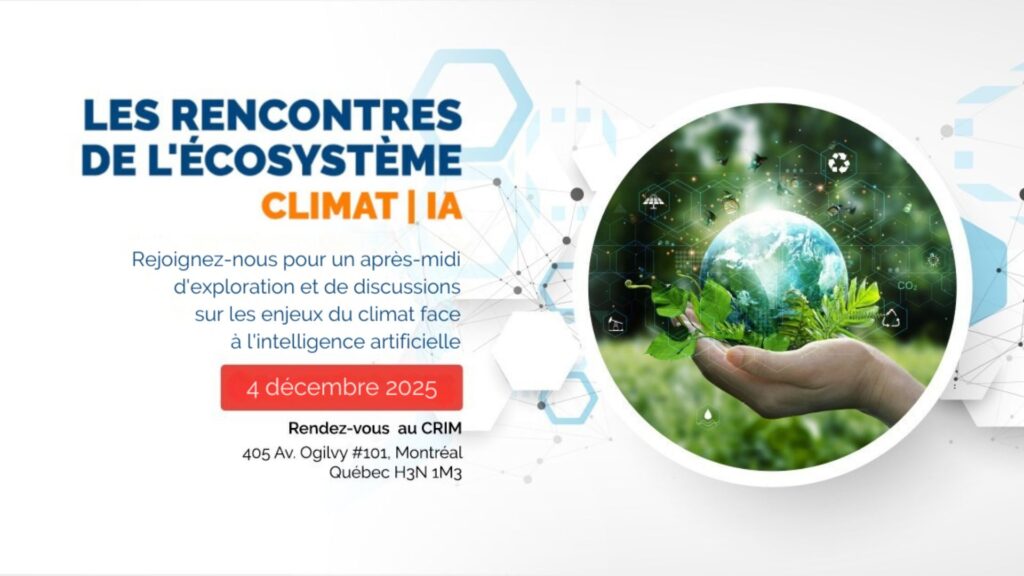
The next edition of Rencontres de l’écosystème | Climat et IA, will take place on December 4 at CRIM. CRIM would like to thank Innoprofits, the event’s cocktail partner.