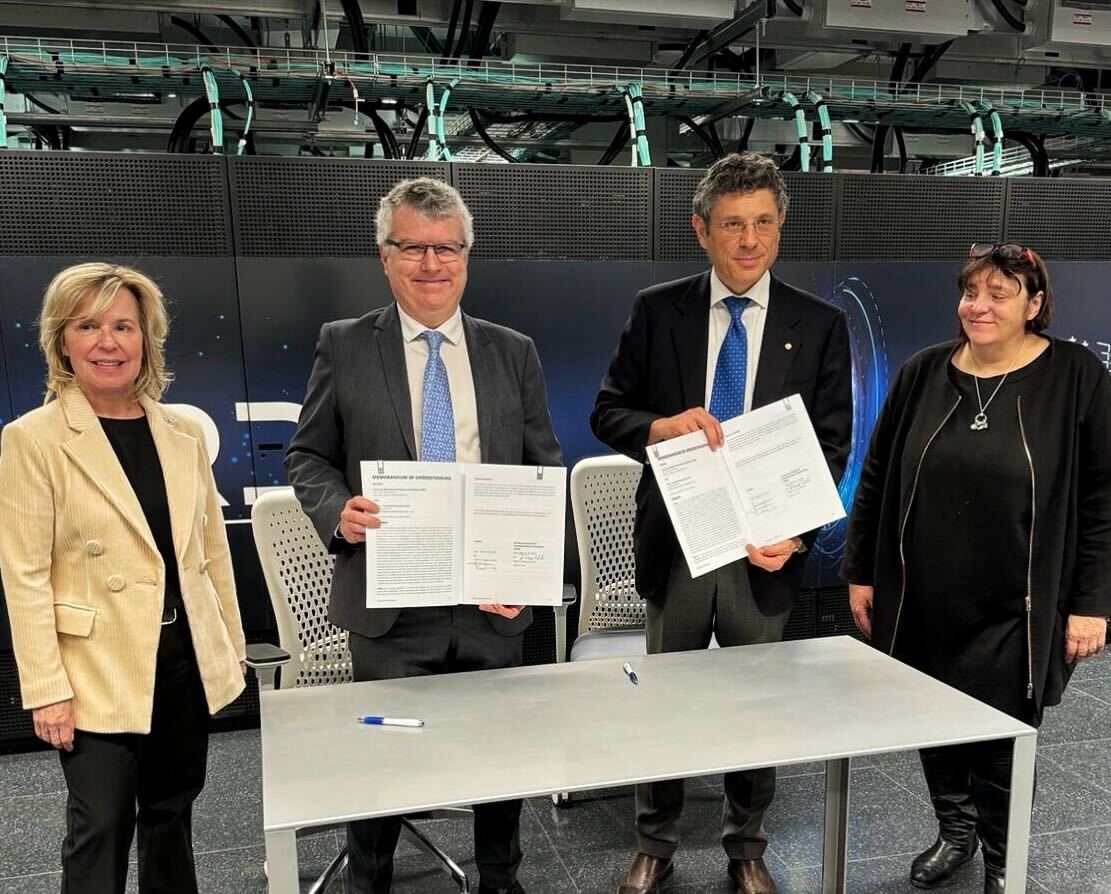
Bologna, February 27, 2024 – CRIM is delighted to officially announce the signing of a strategic collaboration agreement with the Cineca consortium, based in Bologna, Italy. The main aim of this agreement is to enrich both parties’ climate data portals through the introduction of new functionalities and services. The aim is to better meet the varied needs of users, while actively contributing to mitigating the impact of climate change. This collaboration is based on the mutual sharing of knowledge, skills, experience and best practices between our two renowned institutions.
CRIM is also honoured to note that the signing of this agreement took place in the presence of the Minister of International Relations and Francophonie and Minister responsible for the Status of Women, Ms. Martine Biron, as well as several representatives from the Emilia-Romagna region. The Minister expressed her support by declaring: “I salute the agreement between CRIM and Cineca. I’m delighted that Quebec and Emilia-Romagna can collaborate on such an important issue as artificial intelligence applied to climate change.”
Françoys Labonté, President and CEO of CRIM, underlined the importance of this collaboration: “This partnership with Cineca attests to CRIM’s recognized expertise in climate data management and visualization, drawing on our advanced Earth observation skills. We would also like to thank the Quebec government for its presence at the signing, which testifies to the synergy between our expertise and the government’s priorities in the fight against climate change.”
“Collaborating with CRIM confirms our shared commitment to innovation and sustainability,” says Francesco Ubertini, President of Cineca. “Today, the challenges of climate change require rapid and effective responses, which is why we are proud to be able to make our expertise and resources available to support decision-making processes in decisive sectors such as agriculture, energy and water management. I am convinced that by working together, we will achieve significant progress in climate data management, to the benefit of both the environment and society.”
The main thrusts of this collaboration include :
- Enhancing the value of climate data and improving portal functionalities.
- The development of technological tools adapted to different sectors (meteorology, fintech, agritech).
- Inspired by the successes of Quebec’s Confiance IA industrial research consortium, to design a set of tools and methods to promote the responsible and sustainable adoption of artificial intelligence in various industries.
This agreement between CRIM and Cineca is part of a broader multi-sectoral agreement signed between the Government of Quebec and the Emilia-Romagna region, marking an important milestone in international cooperation for sustainable development and climate technology.
The collaboration agreement between CRIM and CINECA was made possible thanks to the organization of the Canada-Italy AI Forum in November 2023 by the Italian Chamber of Commerce in Canada (CCIC). CRIM would like to thank the CCIC for this crucial role.
About CRIM: The Centre de recherche informatique de Montréal (CRIM) is a catalyst for innovation in information technology and a key player in scientific progress. CRIM enables organizations, mainly SMEs, to demystify and gain access to cutting-edge technologies such as artificial intelligence, in order to effectively resolve the technological issues they face.CRIM’s researchers and IT professionals are developing a wide range of applications in a variety of sectors, working in areas of expertise such as machine learning, computer vision, speech recognition, natural language processing, data science and operations research.
As a non-profit organization, CRIM’s neutrality and the strength of its network make it an indispensable resource. Its actions are in line with the policies and strategies steered by the Ministère de l’Économie et de l’Innovation, its main financial partner.
About Cineca: Cineca is a non-profit consortium and Italy’s largest supercomputing center, one of the most important in the world. It operates in the field of technology transfer through high-performance scientific computing, the management and development of networks and web services, and the development of complex information systems for processing large quantities of data. It develops advanced IT applications and services, acting as a link between the academic world, the world of pure research and the world of industry and public administration.