
The building code and natural disasters
It’s not just citizens and farmers concerned about climate change. Building professionals are also concerned about the vulnerability of infrastructure to climate.
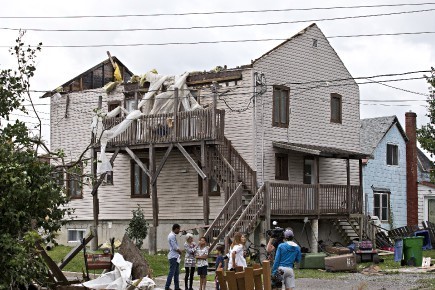
Lachute tornado summer 2017. Credit: La Presse
According to a report [1] by Ouranos, which summarizes our knowledge of climate change in Quebec, the frequency of convective precipitation such as severe thunderstorms is projected to increase. “The latter would produce increasingly large quantities of precipitation. Convective processes are the source of phenomena that generate extreme events with a high potential for damage”.
Although there is no scientific proof of causality between climate change and the appearance of tornadoes, “there are several indications that their number could increase in the coming years. And climate change could be responsible [2],” says Alain Bourque, General Manager of Ouranos, a research consortium specializing in adaptation to climate change. Indeed, climate change favors the appearance of ingredients conducive to the formation of a tornado, such as warm, humid air, instability and wind shear. What’s more, damage caused by tornadoes has doubled every five to seven years since the 1960s, causing concern among building and environmental professionals.
Another major natural hazard is flooding: according to a study prepared by the Intergovernmental Panel on Climate Change (IPCC)climate change is said to have a visible influence on variables contributing to flooding, such as rainfall and snowmelt.
Particularly in Quebec, “climate models agree on increases in winter and spring precipitation totals”. This would mean more frequent episodes of rain on snow, resulting in an accumulation of water on still-frozen soils, which would be less able to absorb these new quantities of water.
A third hazard, with just as great an impact on the building industry, is drought, as discussed in the capsule Climatedata.ca for agricultureIndeed, “projections of soil moisture anomalies show that at least 66% of available CMIP [3] simulations project drier conditions annually, and even more so for the summer season over the 2081-2100 time horizon”. In terms of infrastructure, drought contributes to soil drying. Where soils are predominantly clay, the impact on building foundations can be significant.
If the Quebec Construction Code, which will be incorporated into the National Building Code currently under revision, is to promote carbon neutrality and climate resilience, it must not only take into account historical climate data, but above all be based on climate data that takes into account future climatic conditions (projections).
The importance of climate projections for building professionals
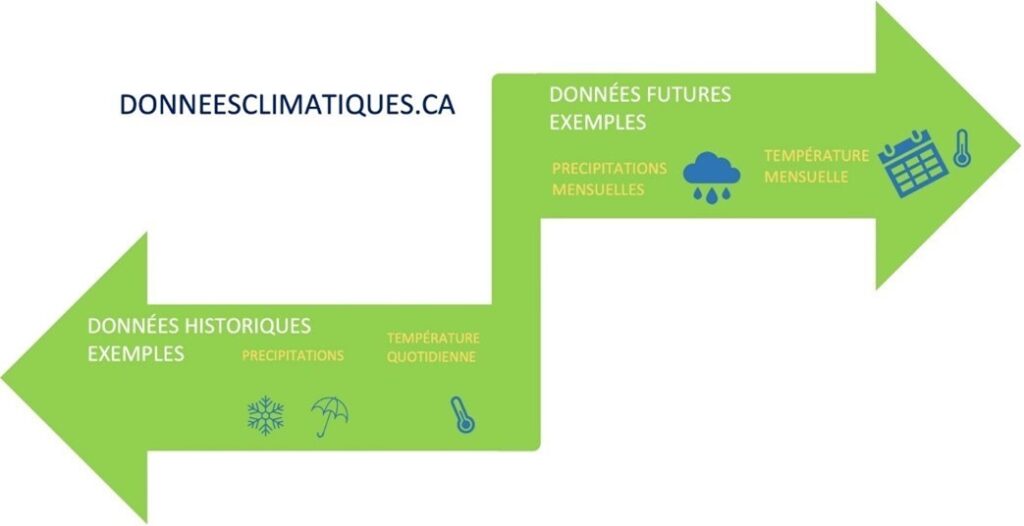
The portal weatherdata.ca portal presents future precipitation and temperature projections. These data are essential, among other things, for estimating the frequency and intensity of extreme events and thus helping planners and other building professionals to better design, build and maintain a built environment that is resilient to current and future climate.
As an example, let’s take the scenario of heavy precipitation (over 20 mm per day) for the Quebec region. Using Donneesclimatiques.ca, we can see a significant discrepancy between historical data for the period 1971-2000 and projected data for 30-year periods (2001-2030; 2031-2060; … 2071-2100).
Until 2001-2030, a small increase in very wet days (20 mm accumulation) is projected. However, the further into the future, the more the models project an increase: in fact, over the period 2071-2100, cumulative precipitation rises from 3.9 to 5 days, as illustrated in Figure 1.
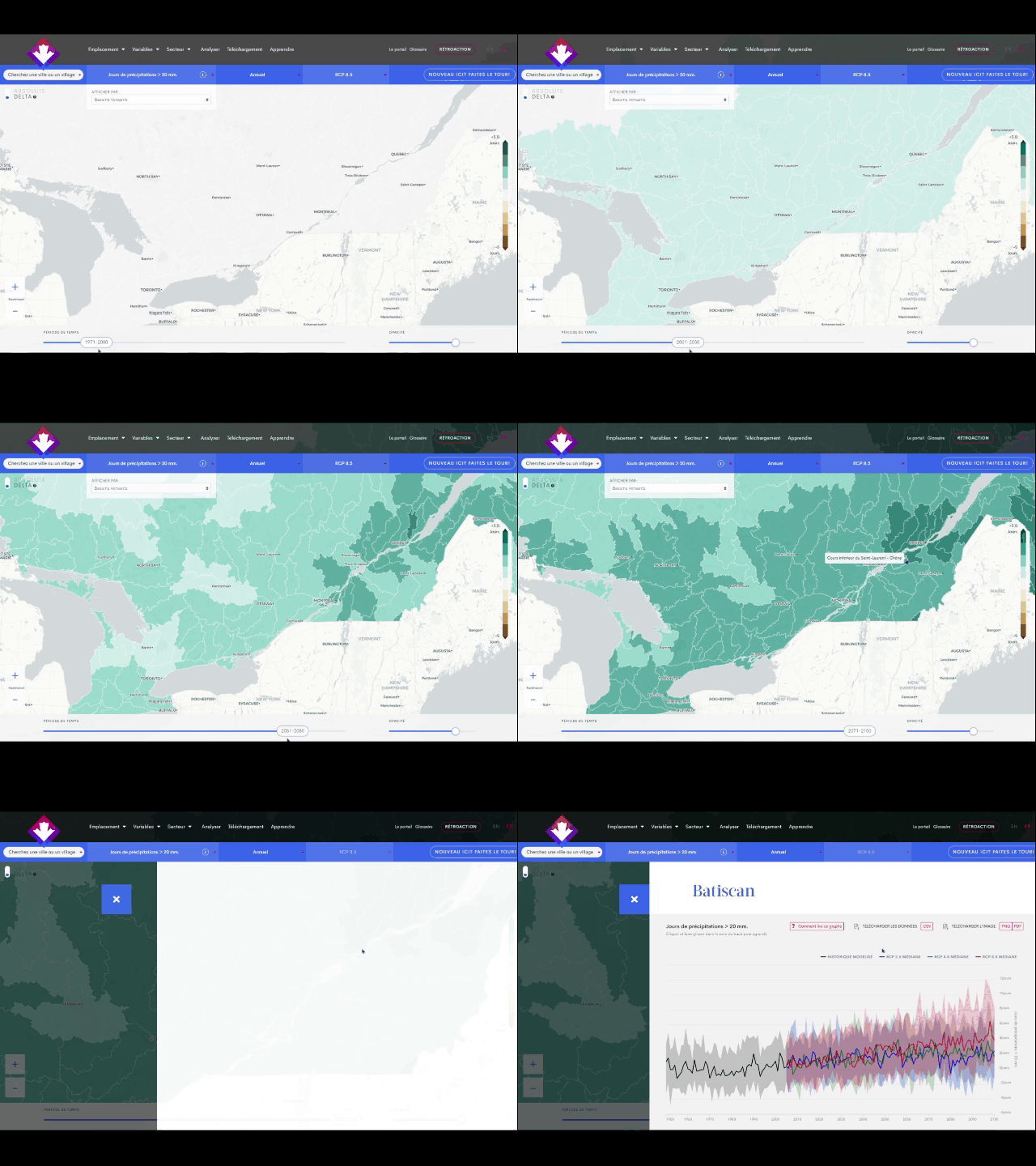
Figure 1: Trends in rates of increase in cumulative rainfall greater than 20 mm, Quebec
With this climatic data, professionals – architects, engineers, contractors, builders, engineering consultants, property developers – can analyze risks and define adaptation strategies for new constructions or improvements to existing buildings:
- In regions where heavy rainfall is forecast, the builder may choose materials that are more resistant to humidity, or the property developer may broaden his search for land to include areas with less clayey soils.
- Other climatic scenarios, such as extreme heat: with the “cooling degree days” variable, professionals in the field will have a clearer idea of future needs in terms of thermal management of buildings, and will be able to act upstream, whether for new constructions or renovations. Several strategies could be implemented: better insulation, natural and mechanical ventilation, geothermal systems, etc.
A “Building” module will soon be available on Weatherdata.ca , providing building professionals with easy access to the relevant data they need to consider in their choices of design, location, materials, operations and so on.
Thanks to the data and visualizations available on Climatedata.ca, the building community will be able to identify possible solutions at various stages of adaptation to climate change. Among other things, the case studies in the portal’s Building module offer the following recommendations:
- adjusting design and construction criteria to the new climatic reality;
- revising codes and standards so that climate change is taken into account at every stage in the life cycle of a building or infrastructure;
- adapting to building standards, or even exceeding minimum expectations, as some British Columbia companies do when complying with voluntary regulations BC Energy Step;
- the use of suitable materials;
- Intensified maintenance and asset management that takes climate change into account.
Residential buildings have a key role to play in adapting to climate change. In some regions of Quebec, builders are encouraged to take advantage of climatic conditions and the characteristics of the chosen terrain to build or renovate comfortable, energy-efficient homes.
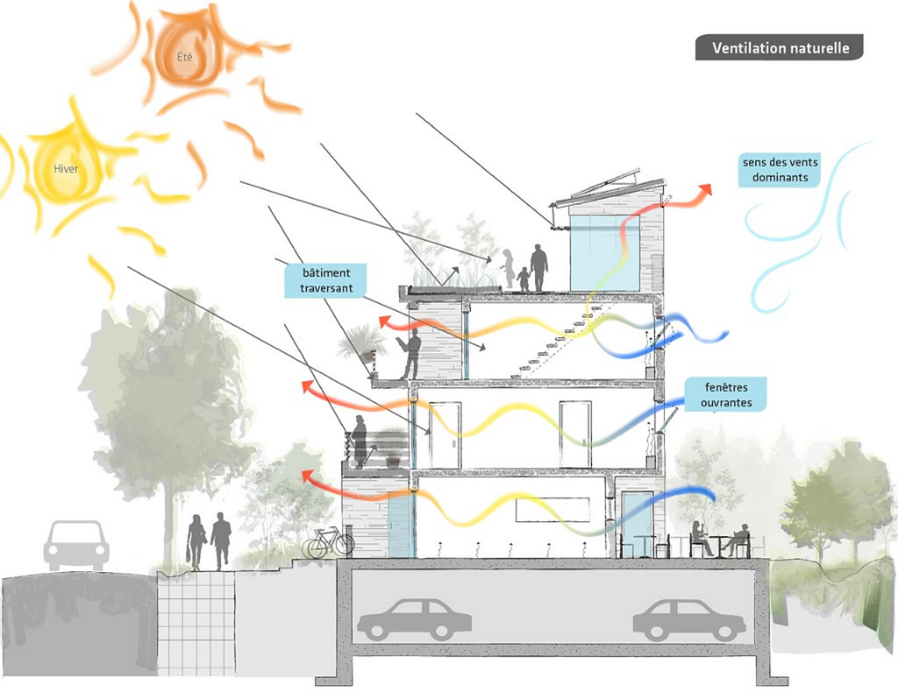
Source : Construireavecleclimat.org
This method has many advantages:
- New constructions and renovated buildings are better insulated and generate fewer greenhouse gases.
- People live and breathe better, reducing the number of climate-related illnesses and deaths.
- Society as a whole is taking part in the global movement to adapt to climate change, and accelerating the sharing of best practices.
Donneesclimatiques.ca, a user-friendly tool, offers a glimpse into the future, generating climate projections up to the year 2100. By anticipating the future impacts of climate change more accurately, professionals in the building industry and other sectors will be able to make the best decisions to reduce the risks to the public.